Services
Longdyke Colliery at Bilton Banks

Bilton Banks was a village in Northumberland adjacent to the coal mines of Shilbottle but just in the parish of Lesbury. It was home to many miners’ families from the late 19th century through to the mid 20th century when the mines were finally closed and the houses condemned and demolished. Today there is nothing to show that a close-knit community of families lived and worked here labouring to bring up the coal needed to meet the demands of growing industries.
Coal mining has been associated with this area of north east England for many hundreds of years. It is believed that monks from nearby Hulne Priory near Alnwick were mining coal in the area from around the 12th century and written records from the 16th century exist showing the ownership of coal mines and mining rights in the area. Bell shaped pits were the earliest means of extraction; some were still in use in the 20th century. In 1755 the Earl of Northumberland issued a 21 year lease to William Cooper of Bilton Banks for the development of a ‘colliery’ at Longdyke. Plans of Bilton Bank Estate dated 1813 show two bell pits at Longdyke while John Taylor’s 1805 map of Greenrigg shows 19 bell pits in a dog-leg formation between Greenrigg House, Spy Law and Bilton Village. (Map shows extent of coalfield within the parish).

Shallow mines some 80 feet deep were in use from the 16th century but by 1780 deeper mines over 200 feet deep had been developed. When extraction became too difficult a new shaft was sunk. The mine most associated with Bilton Banks community was the Longdyke Pit. It was sunk in about 1844/5 at a depth of about 150 feet, the shaft being ten and a half feet in diameter. Coal was transported underground on a system of carts and rails.
The carts were towed by pit ponies who lived for many years in the mines, never coming up into the sunlight until they were retired. The mine operated three shifts of miners. Deaths and day to day injuries were common, after all, mining was a dangerous occupation. The most common cause of death was often recorded as “Fall of Stone”. Longdyke colliery, once very profitable, was abandoned on 19 August 1925 and the men employed there, about 150 in all, were transferred to the recently opened Grange Pit.

The Village
In 1874 Fredrick Wilson, the sanitary inspector, painted a damming picture in his report about the housing conditions in Shilbottle. In this report he stated that ‘the prosperity of the (Longdyke) Pit ‘. . . has caused a demand for houses and too much crowding for want of them. . . . the dwellings are of an unsanitary kind . . . rotten old privies, choked drains and water not fit for drinking’.
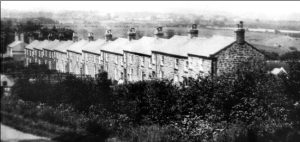
To help solve this problem the new village of Bilton Banks was built adjacent to Longdyke colliery. It comprised two parallel rows of terraced houses, 19 houses in a long row and seven in a shorter row. Set about 60 feet back from the road, each house in the long row had a large front garden, and sixty feet behind them was the short row.

This photograph shows the ‘long row’ with the manager’s house at the far end.
Between the two rows ran an un-drained, uneven, compressed clay walkway alongside which earth closet ‘privies’ (or ‘netties’) were positioned. A single water supply, in the form of a stand-pipe, was situated at the end of the short row. Outside the back door, each house had its own rainwater barrel [1] fitted with a wooden lid to keep out dust and dirt from the pit. Set apart from these terraces, a larger house was built for the manager. Much of the stone for these houses was taken from the local quarry at Spy Law, a hundred yards away. Prior to the building of these houses miners would have walked into work from Alnwick, Alnmouth and Warkworth as well as Shilbottle.
Living conditions were spartan with a single kitchen / living room below, two bedrooms above and, for most, no inside sink, bath or toilet facilities. Indoor lighting was by paraffin lamps and candles. A lean-to wash house with sink and pantry were later added to the rear of the house. The enclosed ‘privies’ consisted of a wooden seat with a hole in it and under which was positioned a large galvanised bucket. A short walk away beyond them were the middens into which ashes and all household waste was emptied. This was collected weekly by the ‘night soil men’ using wheelbarrows, shovels, and horse and cart.
Although the householders’s aim had always been to keep vermin at bay, residents often reported infestations of rats, bugs and beetles in their homes; despite their best efforts, infectious diseases remained very common. In his reports to the Health and Housing Committee Doctor Scott Purves, the medical officer of health from Alnwick, frequently drew attention to outbreaks of infectious and contagious diseases such as measles, scarlet fever and chicken-pox; deaths from diphtheria and pulmonary tuberculosis (TB) were not uncommon.
With the poor state of the nation’s health, highlighted by the poor quality of recruits offered to the military, national health became a government concern between the wars and various housing acts transferred responsibility for working class housing, sanitation and living conditions to local authorities. In January 1937 and armed with these powers, Alnwick Council gave notice to the Duke of Northumberland (the owner) that the houses at Bilton Banks would be inspected under Section 127 of the Housing Act 1925. In his report, submitted just one month later, Doctor Purves condemned all the houses and recommended that the occupants be re-housed. It wasn’t until 1959 that the last house was demolished.
Although the condemned, empty and derelict houses remained standing for 20 years they still served a purpose; in the severe winter of 1947, which brought much of the UK to a standstill, sheep from the local farm at Longdyke were sheltered in the empty houses!
References
Bilton Banks; the Pit and its People by Barry Stewart published 2012
https://wikishire.co.uk/wiki/Bilton_Banks,_Northumberland
www.fusilier.co.uk – a forum and general history source for Amble and district.
John Green’s notes about living and working at Bilton Banks (held at Woodhorn Museum)
Discussions with Billy McKnight
[1] In his account Green says that every housewife, after cleaning the men’s leather boots, would leave them, especially in the summer, outside on the rain barrels to dry. After one nightshift, all the boots that had been left out were ‘shuffled like dominoes’ by one of the returning miners. The miners on the next shift were up to two hours late clocking on and, because they were paid on piece rates, were exceedingly angry. Green states that his ‘knowledge of swearwords’ began that morning!
Thanks to Mike Norris and Clive Church for their research.